Publications

The bioethics of VR Potter:
concepts, uses and meaning
This collection brings together essays by various scholars who explore bioethics from the perspective of Van Rensselaer Potter, one of the pioneers in the field. V.R. Potter's Bioethics: Concepts, Uses, and Meaning takes the reader on a fascinating journey from the origins of the term "bioethics" to its varied modern applications in a globalized and interdisciplinary context. The book examines in detail how bioethics can be an essential and vital tool for solving complex ethical problems in crucial areas such as health, the environment, and scientific research. Intended for academics, professionals, and students from diverse disciplines, this work offers a critical and comprehensive analysis of how the bioethical principles developed by Potter continue to influence, shape, and enrich ethical discussions in the contemporary world.

The pioneers of bioethics
Originally organized by Giovanni Russo and translated into Portuguese by Diego Carlos Zanella, this collection of works highlights the enduring value of bioethical reflections in the face of dilemmas that span health, science, and the environment.
This book presents the founding ideas of one of the most decisive fields of contemporary thought: bioethics. Bringing together texts by names such as Van Rensselaer Potter, Edmund D. Pellegrino, Warren Thomas Reich, Hugo Tristram Engelhardt Jr., Tom L. Beauchamp, Daniel Callahan, and Robert M. Veatch, the work traces a complete overview of the origins and developments of this fundamental area.
The work explores the medical dimension of bioethics, as well as its links to ecology, individual autonomy, and social responsibility, allowing the reader to understand the breadth and depth of contemporary dilemmas.

History of bioethics in Brazil
Bioethics produced in Brazil is quite comprehensive; however, most published works address moral conflicts related to the bioethical aspects of public health. Thus, these publications identify a priority for the principle of justice, with a clear link between ethics and politics, and connections to the Public Health Movement. This bioethics "made in Brazil" adopts some of the demands of public health, such as the universalization of health services and the allocation of resources to health, and incorporates other aspects related to the socioeconomic dimension and quality of life. "In fact, although bioethics in Brazil has existed since the 1990s, its products are not sufficiently known, nor are the true reasons for this lack of awareness." Therefore, it is in this context that the present work is situated, as it seeks to understand the "products" of "bioethics made in Brazil." Knowledge of these products allows us to understand the complex totality in which bioethics has been developed and produced in Brazil. In this sense, the present essay is organized into five chapters that aim to present the events, facts, and context from which bioethics developed and became institutionalized in Brazil (excerpt from the Introduction).

The bioethics of VR Potter:
50 years later
What would great scholars say if they lived to see the moment when society and the academic community recognize their theories? As early as 1970, Van Rensselaer Potter (1911-2001) had a vision beyond the obvious when he (re)created the concept of bioethics, understanding it to be more about "the science of survival" than "the ethics of doctors."
Today it is clear that Potter was right when he defined it that way. What has not always been clear is his view that bioethics does not originate in medical interventions that seek to save human lives through transplants, genetic modification, and so many other "new" sciences and technologies available to medicine. For Potter, the science of survival goes beyond medical ethical issues, taking into account all the biological, community, cultural, and relational aspects of human beings within the ecology of the natural world.
Fifty years after Potter's contribution, this book, organized by Anor Sganzerla and Diego Carlos Zanella, does more than reconstruct his path and reflect on what bioethics has meant in half a century of history. It seeks to anticipate what it is called to be in the future, aware of its great task: to make our conversion not only mental or theoretical, but committed and practical.
Anor Sganzerla and Diego Carlos Zanella are PhDs in philosophy, active members of the Brazilian Society of Bioethics, and have dedicated themselves to research and teaching on topics such as bioethics and technoscience, environmental bioethics, and bioethics and human rights. In this work, they organize the reflections of leading figures in bioethics that corroborate the vision that Van Rensselaer Potter already had in 1970 when he stated: “Global bioethics is proposed as a secular program for the evolution of a morality that will demand decisions in medical care and in the preservation of the natural environment. It is a morality of responsibility. Although described as a secular program, it should not be confused with secular humanism. Global bioethics can coexist with secular humanism as long as it can be agreed that the natural laws that govern the biosphere – in fact, the Universe – will not change according to the desires of individuals, governments, or religious preferences.”
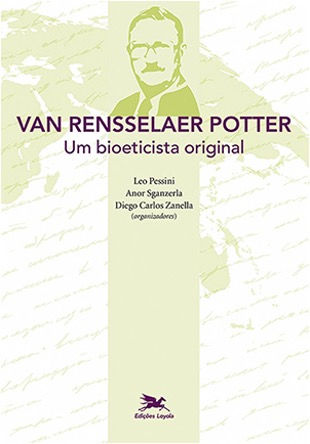
Van Rensselaer Potter:
an original bioethicist
This work is unprecedented in the world's bioethical literature. Composed of articles by Van Rensselaer Potter and other Brazilian and foreign authors, it discusses Potterian bioethics. The book's structure begins with an understanding of the person and work of the one considered one of the "fathers of bioethics" for coining the neologism "bioethics" (1970). Following this, the concepts of bridge, global, and deep bioethics are addressed sequentially in distinct parts. The appendix section contains transcripts of videos that Potter, unable to attend, sent to three world bioethics events at the beginning of the third millennium. In times of ecological crisis, which threatens the future of life on the planet, it is very healthy to consider the cosmic-ecological perspective of this renowned author's bioethics. In it, bioethics and hope go hand in hand as a guarantee of the future of life on the planet.

Global bioethics:
building upon Leopold's legacy
The scope of bioethics is as broad as Potter suspected in 1971 and larger than most people had imagined. Whether one agrees or disagrees with the particular vision he offers, it must be acknowledged that the problems raised by Potter are inescapable. By conceiving bioethics as biology combined with a diversity of humanistic knowledge, forming a science that defines a system of medical and environmental priorities for acceptable survival, Potter makes a rich and important contribution to the kind of discussions and investigations we need to undertake. Beyond the neologism "bioethics," he contributes again in a way that reaches far beyond the particularity of his statements and proposes a general philosophical and moral challenge that we will all have to confront.

Bioethics:
A bridge to the future
Among the most cited works in the bioethics literature, this text has historical value: it introduces the neologism bioethics, intended to structure a large interdisciplinary field. In Potter's original idea, bioethics is a continuous search for wisdom, uniting the efforts of the scientist and the ethicist; it is a bridge to reach a future threatened by scientific and technological progress: a bridge of two arches, biology and ethics. Considered in the past a part of the classical disciplines, today ethics can no longer be separated from a realistic understanding of ecology: ethical values must be related to biological facts; the survival of the entire ecosystem becomes the test of value judgments. The result of more than thirty years of research on cancer, Potter's book arises from the need to look beyond the walls of the laboratory at all the causes that jeopardize the survival of the human species. Centered on such survival, Potter's bioethics assumes the characteristics of an enlightened anthropocentrism that moves towards a "global bioethics" that protects the entire ecosystem. Therefore, the main themes that make up the book's plot are: the relationship between order and disorder, the concept of dangerous knowledge, human progress, the survival of the human species, the obligation to the future, and the need for interdisciplinary effort. These themes come together in a coherent plan, marked by the theme of responsibility, the need to balance the use of knowledge with awareness of the long-term effects of ignorance: an ethics of life, the urgency of which Potter warned in the 1970s and whose necessity is even more urgently emphasized today.

Kantian cosmopolitanism:
From the improvement of morals to the establishment of peace.
Cosmopolitanism is a theory that resurfaces from time to time, but is mostly expressed in adjectival form. However, cosmopolitanism is a Western concept that represents the need for social agents to conceive of a moral, political, and cultural entity larger than their own homeland, encompassing all human beings on a global scale. Cosmopolitanism, therefore, presupposes a positive attitude towards difference, a desire to build broad alliances and global communities – equal and peaceful – of citizens who should be able to communicate and relate to each other beyond cultural and social boundaries, forming a universalist solidarity. Cosmopolitanism defends equality and freedom among people. The citizen of the world – the cosmopolitan – is a person who wishes to transcend the geopolitical division inherent in the local citizenships of different sovereign states and countries.

Education, environment and culture:
interfaces in teacher training
The book Teaching, Environment and Culture: Interfaces in Teacher Training, the second volume in the Teaching and Education collection, is the result of the XVIII National Education Conference and the VI Interdisciplinary PIBID Seminar, an event held in 2016 and promoted by the Franciscan University Center, Santa Maria, RS. It brought together researchers, university and basic education teachers, undergraduate and graduate students to discuss the interactions between teaching, environment and culture.

Teaching and the teaching profession:
Commemorative edition for the 25th anniversary of the National Education Conference.
The work, "Teaching and the Teaching Profession," which we present here, is the result of the collective work of professionals involved with the event in question. Organized into three parts, the book brings together unpublished texts by authors with training in different areas, but with a common goal: teaching as a means of human development. The XVII National Education Conference, held in September 2014, marked the 25th anniversary of this event. In this edition, the Conference also included the IV Interdisciplinary PIBID Seminar, with the aim of promoting reflection on the tasks and challenges of the teaching profession in the areas of creativity, identity, and human valorization, in order to articulate dialogue between the different levels and modalities of education.